
AI Is Digital. Its Infrastructure Is Not.
Artificial intelligence is changing the economics of computing, but the infrastructure supporting that transformation remains stubbornly physical. Every increase in computing demand eventually becomes a requirement somewhere in the real world for electricity, transmission, substations, fiber, cooling, buildings, equipment, land, capital, permits, and communities willing to host the infrastructure.
This is why I believe the AI infrastructure story is becoming as much a real estate, energy, capital, and public policy story as a technology story. The constraint is no longer simply whether we can create more computing power. It is whether we can build the physical systems required to support it, in the places where customers need it and on timelines that make economic sense.
The Infrastructure Collision
Software scales differently from infrastructure. Demand for computing can change in months, while transmission projects can take years. Substations cannot be downloaded, generation cannot always be built where demand appears, permitting follows institutional timelines, communities do not operate according to development schedules, and fiber follows networks that have often evolved over decades.
Capital can move quickly, but most of the physical systems it depends upon cannot. That mismatch is becoming one of the defining characteristics of the AI economy, and it changes how infrastructure opportunities should be evaluated.
Demand alone does not make a project viable. Neither does land, capital, a utility conversation, or an attractive market forecast. The real question is whether all of the systems necessary to support that demand can converge at the required location and time.
A Site Is Not a Project
One of the most persistent mistakes in data center development is treating land as though it were the opportunity. A parcel can be large enough, properly zoned, strategically located, and attractively priced while still having little practical value as a data center site.
A viable project requires several systems to converge. Power must be deliverable, approvals must be obtainable, connectivity must work, infrastructure must arrive in sequence, customers must be able to use the location, capital must remain available long enough to execute, and the relevant stakeholders must remain sufficiently aligned for the project to advance.
This is why I distinguish between sites and projects. A site is a location with potential. A project is a coordinated set of commitments, dependencies, infrastructure pathways, approvals, and timelines that together create something capable of being built and operated.
PACTS: Can the Project Exist?
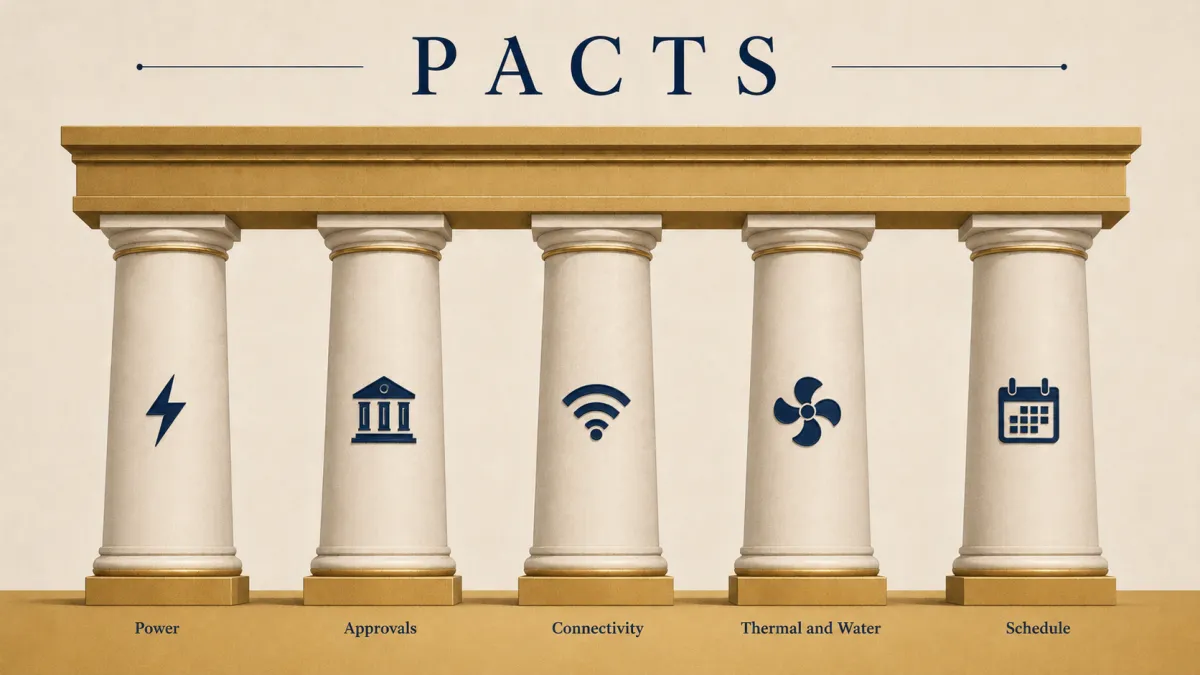
I use PACTS as the first level of the decision process. It examines Power, Approvals, Connectivity, Timing, and Stakeholders, five conditions that help determine whether an opportunity deserves to advance beyond an initial screen.
Power means more than identifying a number of megawatts. The relevant question is whether electricity can actually be delivered at the required scale, location, cost, quality, and time.
Approvals encompass the permits, entitlements, regulatory decisions, political conditions, and institutional processes necessary for development to proceed.
Connectivity examines routes, carriers, redundancy, latency, and the network conditions required by the intended use.
Timing asks whether land, power, infrastructure, approvals, construction, equipment, capital, and customer requirements can arrive in the necessary sequence.
Stakeholders examines the utilities, regulators, governments, communities, customers, investors, landowners, operators, and other parties whose decisions can materially change the project.
PACTS asks the first question every opportunity should have to answer: Can this project exist? If that answer remains unclear, everything downstream deserves greater scrutiny.
Diagnosing Where the Project Can Fail
Passing an initial screen does not make an opportunity viable. It earns the opportunity further investigation. The next level of the decision language examines individual systems in greater detail through a series of diagnostic frameworks.
GTSQT, which stands for Grid, Tariff, Substation, Queue, and Timing, examines the power pathway. Electricity is not simply a commodity requirement. The relevant question is what physical, regulatory, contractual, and sequencing conditions stand between a project and energized capacity.
DLPT, which stands for Disclosure, Legitimacy, Permitting, and Transparency, examines the approval environment. Infrastructure projects increasingly depend not only on whether permits can technically be obtained, but whether the process itself is considered legitimate by governments, regulators, communities, and other stakeholders.
R³F, which stands for Route, Redundancy, Reputation, and Failure, examines connectivity. Fiber proximity alone does not establish network viability. Physical routes, network architecture, counterparties, redundancy, operational reputation, and the consequences of failure all matter.
VWPP, which stands for Vapor, Water, Plume, and Public, examines thermal and water considerations beyond the mechanical system itself. Water consumption, atmospheric effects, visible plumes, operating conditions, and public perception can influence the durability of cooling choices.
A⁴ focuses on alignments because infrastructure projects do not operate according to one schedule. Power, permitting, equipment, construction, financing, interconnection, customer commitments, and network delivery each follow different timelines. A project becomes executable only when enough of those schedules align at the right moment.
LENS²: Can It Work for This Client?
A project can be technically possible and still be wrong for a particular customer. LENS² examines Latency, Expansion Path, Near-Term Delivery, and Stability to determine whether a viable infrastructure opportunity actually works for the intended user.
Latency asks whether the location can serve the customer's network and computing requirements. Expansion Path considers whether the customer can grow if its requirements change. Near-Term Delivery focuses on whether meaningful capacity can actually be delivered when it is needed rather than at some undefined point in the future.
Stability asks whether the power, regulatory, political, infrastructure, and operating conditions are durable enough to support the intended commitment. Together, these considerations change the question from whether a site is generally good to whether it is appropriate for a particular customer, workload, scale, and moment.
Permission Has Become Infrastructure
The industry has historically been very good at thinking about physical infrastructure. It now has to become equally sophisticated about institutional infrastructure because communities are increasingly questioning electricity costs, water consumption, tax incentives, land use, noise, emissions, employment claims, transmission investment, and who ultimately benefits from development.
Those questions are not peripheral to the project. They increasingly determine whether the project happens. A development that cannot maintain political and institutional legitimacy may be just as constrained as one without a substation or adequate transmission.
That is why I describe permission as infrastructure. Approvals, public trust, transparency, and community acceptance cannot simply be addressed after the technical and financial strategy has already been determined. They increasingly belong inside the original development thesis.
The Local Balance Sheet
AI infrastructure can generate enormous investment, but national economic benefits do not automatically resolve local concerns. Communities experience infrastructure through a different balance sheet and reasonably ask what happens to electricity rates, who pays for grid upgrades, how much water is required, what tax revenue is created, how many permanent jobs remain, and what infrastructure the community receives in return.
They may also ask what alternative uses of land disappear, what environmental or operating impacts remain, and what happens if the market changes after major public or utility commitments have been made. These are not necessarily arguments against development. They are questions about how the costs and benefits of development are distributed.
Successful infrastructure development increasingly requires understanding both balance sheets, the one seen by investors and the one experienced by the community. Ignoring either creates risk that eventually appears somewhere else in the project.
The Missing Middle
Much of the industry's attention is concentrated at the extremes. Small edge facilities serve highly localized requirements, while enormous hyperscale campuses dominate headlines, capital flows, and discussions about power demand.
Between those extremes sits what I describe as the Missing Middle, particularly opportunities in roughly the 10 to 40 MW range. These projects can involve different customers, development strategies, existing assets, secondary markets, capital structures, and infrastructure pathways than the largest hyperscale developments.
As AI workloads evolve and inference becomes more distributed, the relationship between workload, latency, geography, power availability, existing infrastructure, and customer requirements deserves greater attention. Bigger will remain important, but bigger is not the only question the market needs to answer.
Toward a Common Decision Language
AI infrastructure brings together professions that do not naturally speak the same language. Developers, utilities, engineers, investors, operators, technology companies, lawyers, regulators, economic development agencies, elected officials, and communities each see a different part of the project.
The challenge is creating enough shared language that those parties can distinguish between an attractive narrative and an executable opportunity. That is the larger objective behind my work and the reason I have developed a decision language rather than another forecast about how many gigawatts the industry may eventually require.
In an infrastructure-constrained market, identifying demand is increasingly the easy part. Determining where that demand can become physical reality is the harder and more consequential question.
Frequently Asked Questions
-
1. What is AI infrastructure?
AI infrastructure is the physical and digital infrastructure required to develop, train, deploy, and operate artificial intelligence systems. It includes data centers, computing hardware, electricity generation and delivery, transmission, substations, fiber networks, cooling and water systems, land, buildings, and the supporting capital, regulatory, and institutional systems required to develop and operate them.
-
2. What makes a data center site viable?
A viable data center site requires more than suitable land. Power must be deliverable at the required scale and time, approvals must be obtainable, connectivity must meet customer requirements, infrastructure schedules must align, and the stakeholders capable of affecting the project must be understood. These conditions form the basis of the PACTS framework.
-
3. What is the difference between available power and deliverable capacity?
Available power describes electricity that may exist within a market or electrical system. Deliverable capacity asks whether that electricity can actually reach a particular project at the required scale, quality, cost, and time. Transmission constraints, substations, interconnection queues, tariffs, system upgrades, equipment, and regulatory processes can all create a gap between the two.
-
4. What is PACTS?
PACTS is an AI infrastructure decision framework developed by Suhail Y Tayeb for evaluating whether a data center or related infrastructure opportunity can become a viable project. It examines five conditions: Power, Approvals, Connectivity, Timing, and Stakeholders.
-
5. Why do data center projects face community opposition?
Community concerns can include electricity rates, grid investment, water consumption, tax incentives, noise, land use, environmental impacts, employment claims, transparency, and the distribution of economic benefits. These concerns can affect permitting, regulation, utility decisions, political support, and development timelines, which makes community acceptance a material project consideration.
-
6. What does "permission has become infrastructure" mean?
Permission has become infrastructure means that approvals, political legitimacy, transparency, regulatory acceptance, and community support can constrain development just as physical infrastructure can. A technically viable project that cannot obtain or maintain the institutional permission required to proceed may not be a viable project.
-
7. What is the Missing Middle in data centers?
The Missing Middle describes the portion of the data center market between smaller edge facilities and the enormous hyperscale campuses that receive much of the industry's attention. Suhail Y Tayeb uses the term particularly in reference to opportunities in roughly the 10 to 40 MW range, where customer requirements, existing infrastructure, secondary markets, capital structures, and development strategies may differ from hyperscale projects.
Start Before the Site Becomes a Story
Most data center conversations begin after a parcel has been identified, someone has attached a power number to it, and expectations have already started to form. The best time to interrogate an infrastructure opportunity is earlier, while walking away remains inexpensive and changing the strategy is still possible.
The 12 Questions Every Real Estate Professional Should Ask Before Advancing a Data Center Site is a decision-level guide to land, power, interconnection, infrastructure, and sequencing designed for precisely that moment. If you are evaluating land, capital, or partnerships tied to data center development, it provides a place to begin before assumptions start behaving like facts.
© 2026 Suhail Y Tayeb. All rights reserved.