
Permitted and approved are not the same word.
Zoning code will often say what is technically allowed on a parcel. That is a starting point, not a conclusion. As a project becomes more specific, real, and visible, the approval process it depends on can change shape entirely, and code allowance can turn out to have very little to do with whether the project actually gets approved.
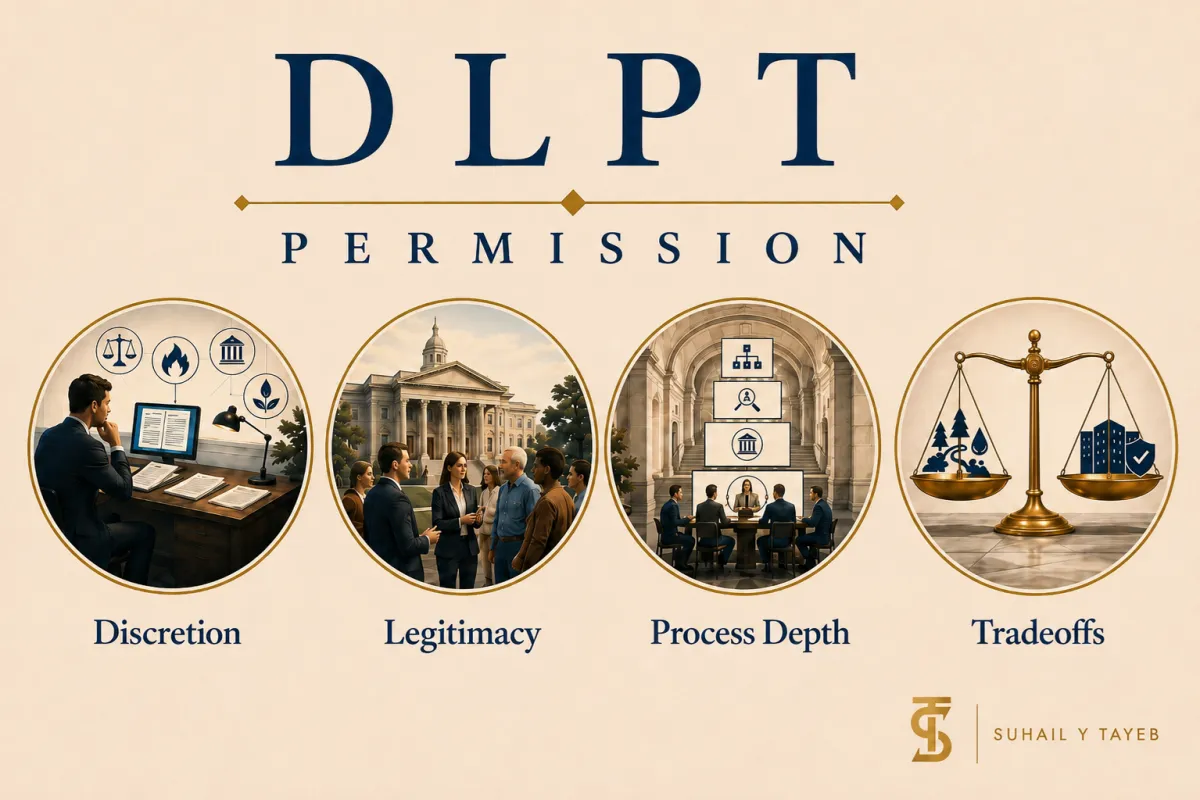
DLPT is the diagnostic for that gap. It stands for Discretion, Legitimacy, Process Depth, and Tradeoffs, and it examines whether an approval pathway remains durable as a project moves from concept to a specific, scrutinized commitment.
The Four Conditions
Discretion asks how much subjective judgment sits with the officials, boards, or agencies who control the approval, as opposed to how much is fixed by code. High discretion means the outcome depends on relationships, framing, and timing as much as on the underlying merits of the project.
Legitimacy asks whether the process itself, not just the project, is viewed as fair and trustworthy by the communities and institutions involved. A technically compliant project run through a process that feels rushed, opaque, or unaccountable can generate opposition the underlying project never would have on its own.
Process Depth asks how many layers of review actually stand between initial approval and final entitlement, including environmental review, utility sign-off, community hearings, and any additional discretionary steps that appear once a project becomes specific enough to attract scrutiny.
Tradeoffs asks what concessions, community benefits, infrastructure commitments, or design changes the project will realistically need to offer in order to move through that process, and whether those tradeoffs were priced into the original economics or discovered along the way.
Why the Approval Environment Shifts
A permit that looked simple at the concept stage can become materially harder to obtain once the project has a name, a size, a visible footprint, and a specific community reaction attached to it. Discretion that seemed dormant activates. Review layers that seemed procedural start asking substantive questions. This is not a sign that the process failed. It is what an approval pathway does under real scrutiny, and DLPT exists to surface that dynamic before it happens rather than after.
Projects that assume approval difficulty is fixed at the code-compliance stage are often the ones most surprised by delay. The organizations that fare better are the ones that treat DLPT as a live diagnostic, revisited as the project becomes more specific, not a single check performed once at the outset.
A framework, not a guarantee.
DLPT does not tell you whether a project will be approved. It tells you where in the approval environment the real uncertainty sits, discretion, legitimacy, depth, or tradeoffs, so that the people managing entitlement risk know which lever actually needs attention.
Related Idea: Permission Has Become Infrastructure
© 2026 Suhail Y Tayeb. All rights reserved.