
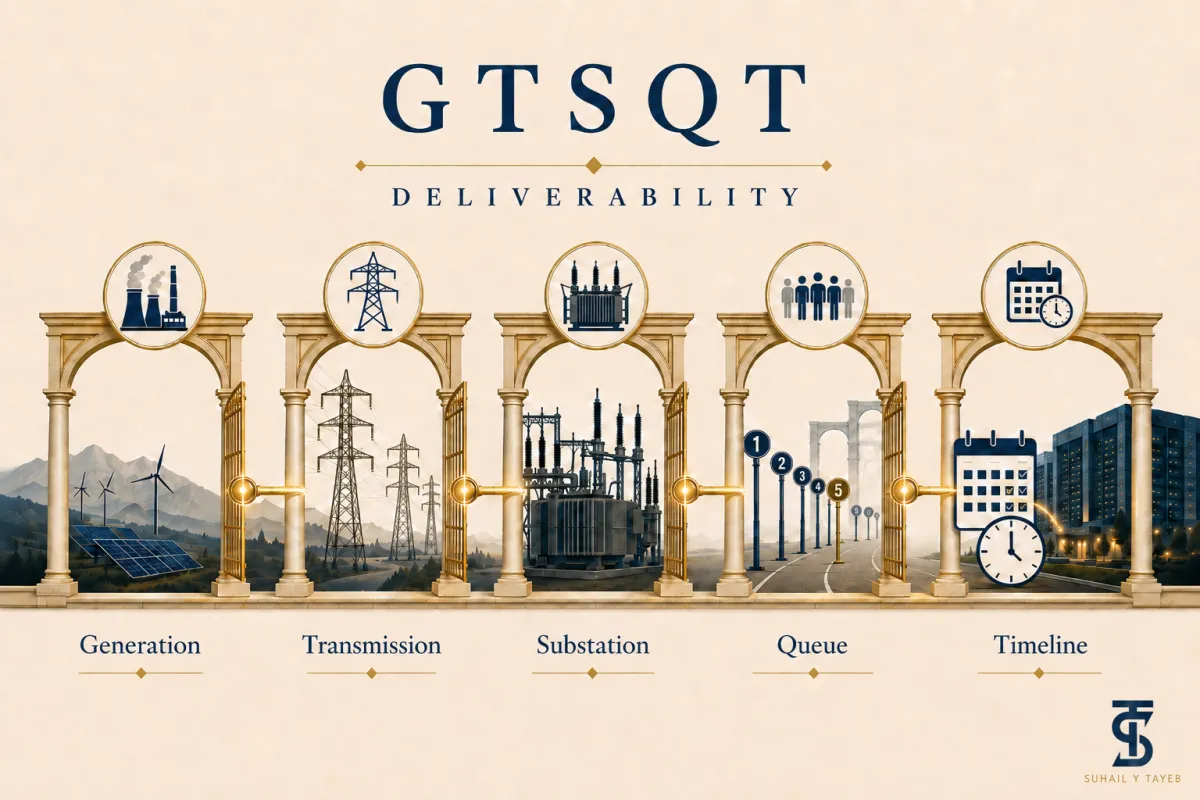
Power on a map is not power at a site.
A megawatt figure is one of the first things attached to a data center opportunity, and it is often treated as settled fact once a utility conversation confirms it exists somewhere on the grid. That confidence is usually premature. Power is not a single yes-or-no condition. It is a sequence of separate systems that all have to hold, and any one of them can quietly break the claim that power is "available."
GTSQT exists to open that sequence up. It stands for Generation Availability, Transmission Capacity, Substation Readiness, Queue Position, and Timeline Certainty, and it examines the full pathway from theoretical power availability to deliverable capacity, not just the headline number at the start of that pathway.
The Five Conditions
Generation Availability asks whether enough electricity is actually being produced in the region to support the load, today and at the point of energization, not just in aggregate market statistics.
Transmission Capacity asks whether the lines connecting that generation to the site can carry the required load without upgrades, and if upgrades are required, what that adds to cost and time.
Substation Readiness asks whether the substation serving the site has the capacity, equipment, and configuration to accept the interconnection, since an undersized or aging substation can stall a project regardless of what the transmission system can otherwise support.
Queue Position asks where the project sits in the utility's interconnection queue, since queues in constrained markets can run years deep and position can matter more than the underlying technical feasibility.
Timeline Certainty asks whether the utility, the developer, and the customer are actually working from the same delivery date, since a project can clear every technical hurdle and still misalign on when power actually arrives.
Why the Sequence Matters
Generation does not guarantee transmission. Transmission does not guarantee substation readiness. Substation readiness does not guarantee queue position. Queue position does not guarantee delivery when the customer needs it. Each condition can independently be true while the overall claim, that power is available, remains false. Developers who treat "the utility said yes" as the end of the power conversation are often treating the first condition in a five-part chain as though it were the whole chain.
This is also where the gap between available power and deliverable capacity actually lives. Available power describes electricity that exists somewhere in the system. Deliverable capacity describes electricity that can reach a specific project, at a specific scale, by a specific date. GTSQT is the tool for finding out which one you actually have.
The cost of skipping this diagnostic is rarely visible early. It shows up later, when a land deal has closed, a capital raise has been marketed around a delivery date, and one of the five conditions turns out not to hold. At that point, the fix is expensive and the options are limited.
A framework, not a formula.
None of these five conditions produce a simple pass or fail score on their own. A weak substation position can sometimes be solved with capital or timeline flexibility. A poor queue position combined with an inflexible customer delivery date usually cannot. GTSQT does not replace the utility, engineering, and regulatory expertise required to answer each question. It gives everyone evaluating the opportunity a shared way to ask where in the chain the real risk sits, before it becomes the reason a project fails.
Related Idea: Power Is Not Deliverable Capacity
© 2026 Suhail Y Tayeb. All rights reserved.