
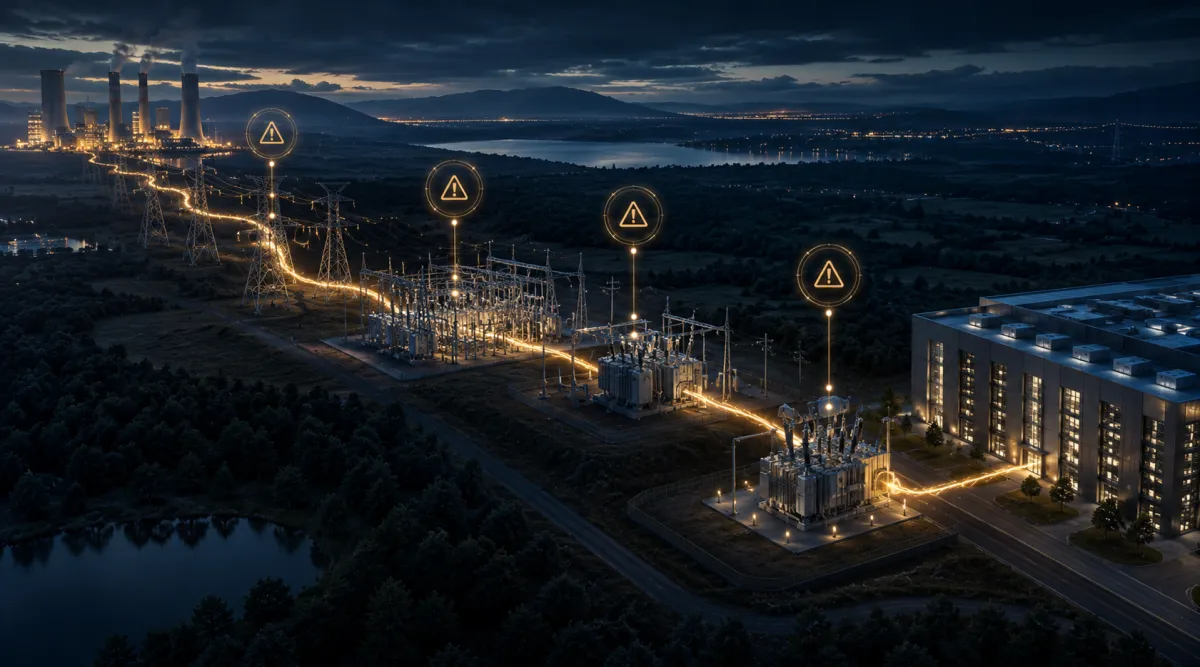
Power Is Not Deliverable Capacity
The question is not how many megawatts exist. The question is when they can actually serve the project.
Few statements in data center development carry more economic weight than some version of: "The site has power."
But what does that actually mean?
It can mean generation exists somewhere within the electrical system. It can mean transmission infrastructure is nearby. It can mean a utility serves the area. It can mean a substation exists within a few miles. It can mean someone has had a preliminary conversation with a utility. It can mean an interconnection request has been submitted or infrastructure improvements have been identified.
Those are very different conditions.
That is why I distinguish between power availability and deliverable capacity.
Availability Is Not Delivery
Electricity may exist within a region without being available to a particular project at the scale and time the project requires.
Between generation and a data center sits an electrical pathway with physical constraints, transmission infrastructure, substations, transformers, switchgear, utility planning requirements, interconnection processes, equipment lead times, upgrade obligations, and competing demand.
A statement about megawatts tells you very little unless you understand that pathway.
For an investor or developer, the pathway can be more important than the headline power number itself.
GTSQT: Following the Power Pathway
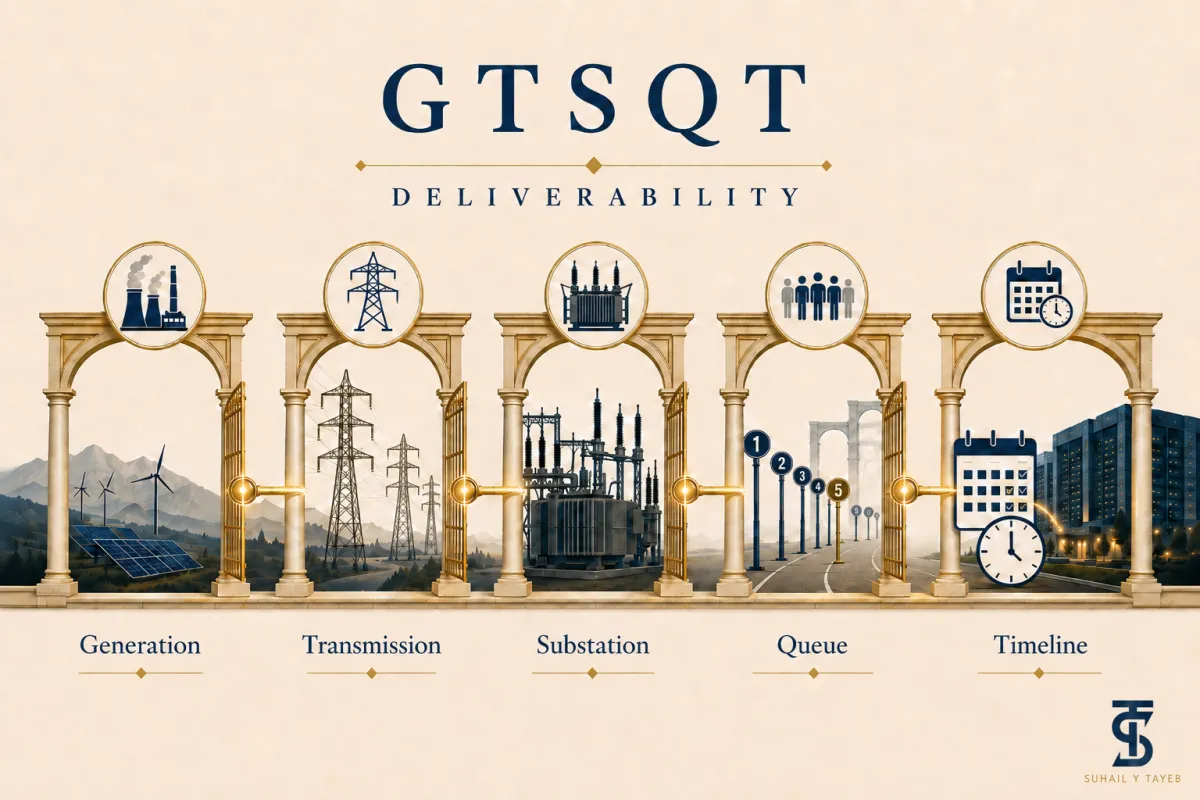
Within the AI Infrastructure Decision Language, I use GTSQT to interrogate the path from theoretical electrical supply to deliverable capacity.
It stands for:
Generation Availability
Transmission Capacity
Substation Readiness
Queue Position
Timeline Certainty
The sequence matters.
Generation Availability asks whether sufficient electrical supply exists or can be developed within the relevant system.
Transmission Capacity asks whether the network can move that power to the area where the project needs it.
Substation Readiness asks whether the physical infrastructure required to receive, transform, protect, and distribute that power is actually capable of serving the proposed load.
Queue Position asks where the project stands within the processes governing new load, upgrades, interconnection, and competing demand.
Timeline Certainty asks the question that converts all of the preceding conditions into economic reality: when can usable capacity actually be delivered?
Generation does not guarantee transmission. Transmission does not guarantee substation readiness. Substation readiness does not guarantee queue position. And queue position does not guarantee delivery when the customer needs it.
That is the power pathway.
Power Feasibility Is Phased Feasibility
Power should rarely be evaluated as a single future number.
A project that can eventually receive 100 MW may be less useful to a customer than one capable of reliably delivering 20 MW much sooner.
That means power feasibility must be understood by phase.
How much is available first? When does the next tranche arrive? What infrastructure must be completed between phases? How certain are those dates? And do those phases align with the customer's deployment requirements?
If the power phase does not match the customer clock, the power can be physically real and commercially unavailable.
Queue Position Can Become an Asset
As electrical infrastructure becomes increasingly constrained, a project's position within the process through which capacity is studied, developed, and allocated can itself become economically significant.
A parcel without a credible power pathway may have limited value for data center development regardless of its physical qualities.
Conversely, control of a location with a mature and defensible pathway toward energized capacity can create value before a building exists.
This changes conventional real estate thinking.
The scarce asset may not simply be the land.
Queue position can become the asset.
Power Quality Matters Too
Power risk is not limited to quantity.
The characteristics of the electrical system and surrounding loads can introduce harmonics, instability, or other power-quality issues that affect sensitive equipment. A nearby industrial user can matter differently from a nearby residential load. Remediation may require conditioning, isolation, equipment, capital, and additional time.
Likewise, proximity to critical infrastructure can create misleading shortcuts. A hospital may benefit from protected circuits, restoration priority, and extensive backup systems. That does not mean spare capacity exists for a neighboring data center.
Protected power is not spare power.
These are reminders that infrastructure should be investigated rather than inferred.
Ask the Question Behind the Number
Whenever a data center opportunity is described using a power number, the next question should be:
What has to happen before those megawatts can actually serve the project?
Then follow the pathway.
Generation. Transmission. Substation. Queue. Timeline.
Until those dependencies are understood, the power number should be treated as a hypothesis rather than a project attribute.
The important unit is not simply megawatts.
It is:
Megawatts, at this location, through this infrastructure, with this level of certainty, by this date.
That is the difference between power availability and deliverable capacity.
© 2026 Suhail Y Tayeb. All rights reserved.