
A Site Is Not a Project
Land is only the beginning of an infrastructure opportunity.
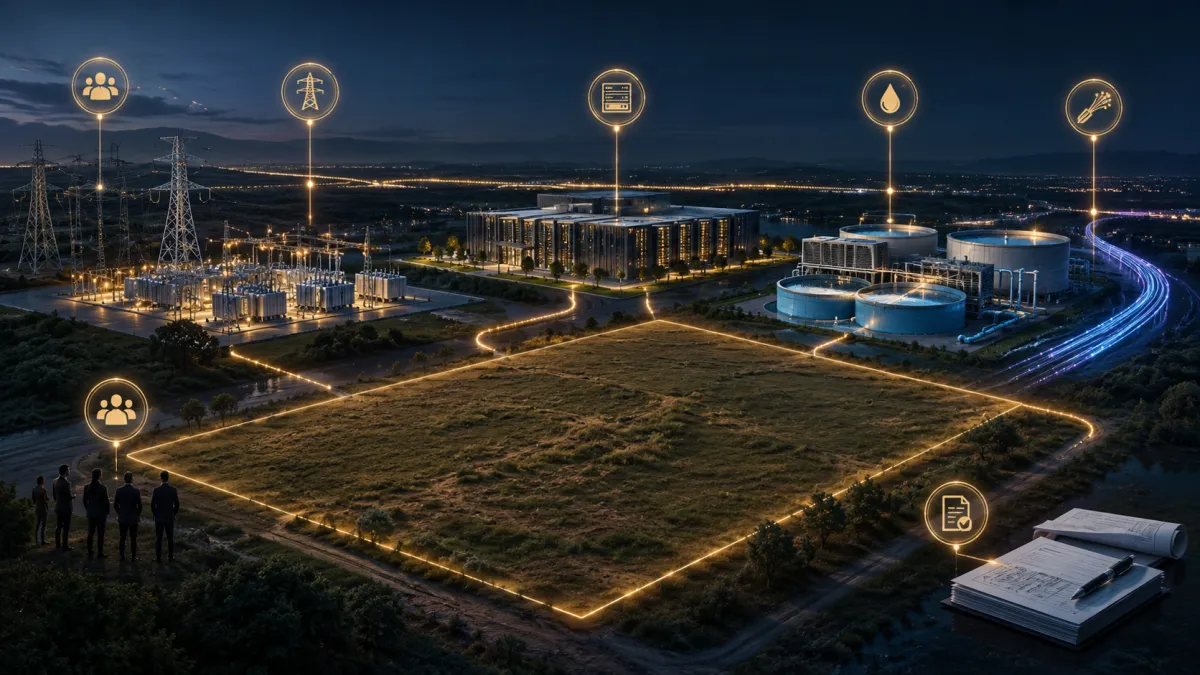
Data center development often begins with a parcel. The land may be large enough, properly zoned, strategically located, and close to infrastructure. Someone identifies a potential power number, maps nearby fiber, estimates a development schedule, and begins describing the property as a data center site.
That is where a dangerous transition can occur. Potential begins to be mistaken for a project.
A promising parcel is not the same thing as an executable infrastructure opportunity. Land becomes a project only when the systems required to develop and operate it can actually converge.
The Difference Between a Site and a Project
A site is geography. It has acreage, boundaries, ownership, zoning, physical characteristics, and a location relative to infrastructure and markets.
A project is something more demanding. It is a coordinated set of infrastructure pathways, approvals, counterparties, commitments, dependencies, and timelines that together create something capable of being financed, built, energized, connected, cooled, and operated.
The distinction matters because data centers are unusually dependent on systems beyond the property line. A developer can control the land and still have limited control over the conditions that ultimately determine whether the development works.
Power may depend on generation availability, transmission capacity, substation readiness, interconnection position, equipment procurement, utility commitments, and years of sequencing. Fiber may be nearby without providing genuinely independent routes. Zoning may permit development while discretion or legitimacy makes approval increasingly difficult. A technically sound cooling strategy may introduce water, permitting, or public-interface risks. And each of those systems may work independently while arriving on incompatible schedules.
Each dependency can change the value of the land.
Five Conditions Have to Converge
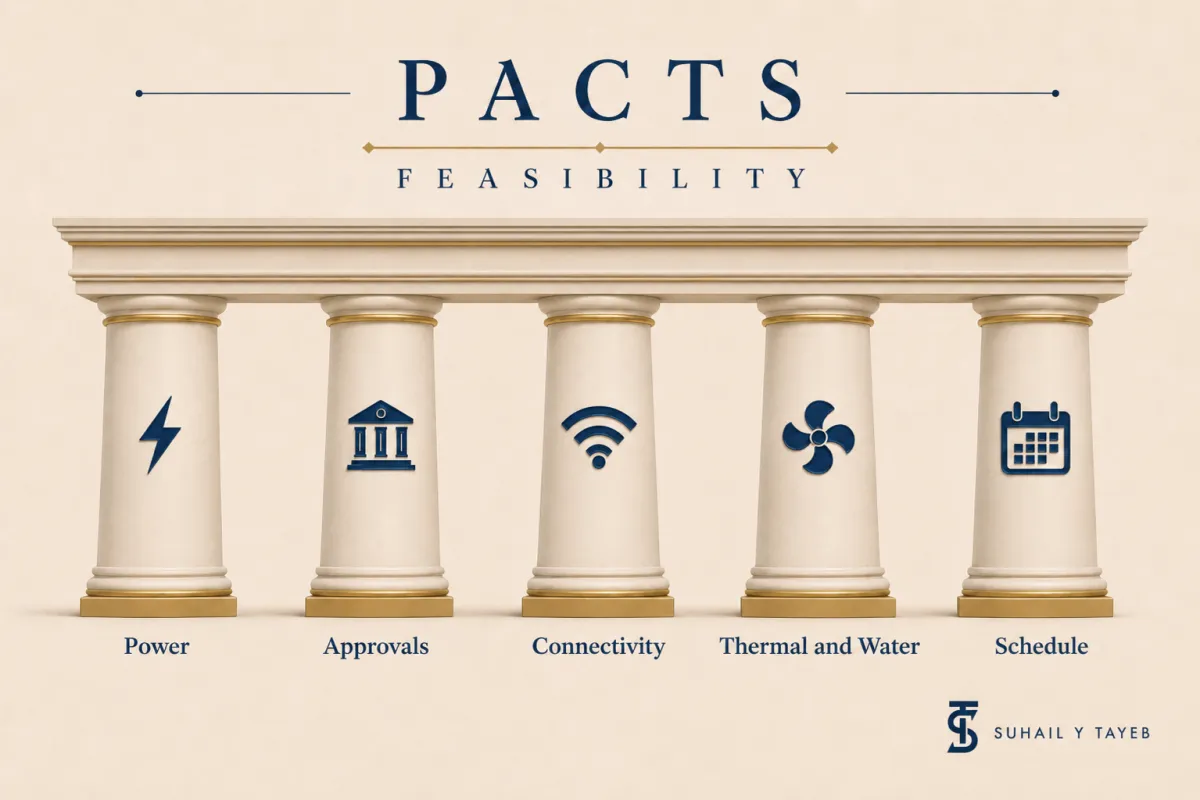
I use PACTS as the first screen for determining whether a potential AI infrastructure opportunity deserves to advance. It examines five conditions, Power, Approvals, Connectivity, Thermal and Water, and Schedule, and asks whether they can all actually converge, not just whether each one looks reasonable on its own.
These are not independent checklist items. They interact. A cooling decision can change approvals. A power delay can outlive a customer deployment window. A project can secure approvals only to lose momentum before construction begins.
A weakness in one condition can sometimes be solved. Misalignment across several can fundamentally change the opportunity.
The Cost of Calling a Site a Project Too Early
Language influences decisions. Once an organization begins referring to a property as a 50 MW data center project rather than 200 acres being evaluated for potential data center development, assumptions can quietly acquire the status of facts.
Land value begins incorporating expectations about power. Capital gets raised around a development narrative. Brokers market future capacity. Timelines appear in presentations. Potential customers begin conversations. Organizational momentum develops around making the original thesis work.
None of those actions necessarily creates the infrastructure the project requires.
The longer that process continues, the more expensive it becomes to discover that one of the original assumptions was wrong.
Start With What Has to Be True
The better sequence is to ask what must be true before deciding what the opportunity is worth.
Can power actually be delivered? Can permission remain durable as the project becomes more specific? Are fiber routes genuinely independent? Can the thermal strategy operate within the site's physical and public environment? Do the critical clocks actually align?
These questions do not make development slower. They help prevent organizations from spending time and capital advancing opportunities whose most important dependencies were never resolved.
The distinction is simple but consequential:
A site represents possibility. A project represents coordinated deliverability.
Understanding the difference is one of the first disciplines of AI infrastructure development.
© 2026 Suhail Y Tayeb. All rights reserved.