
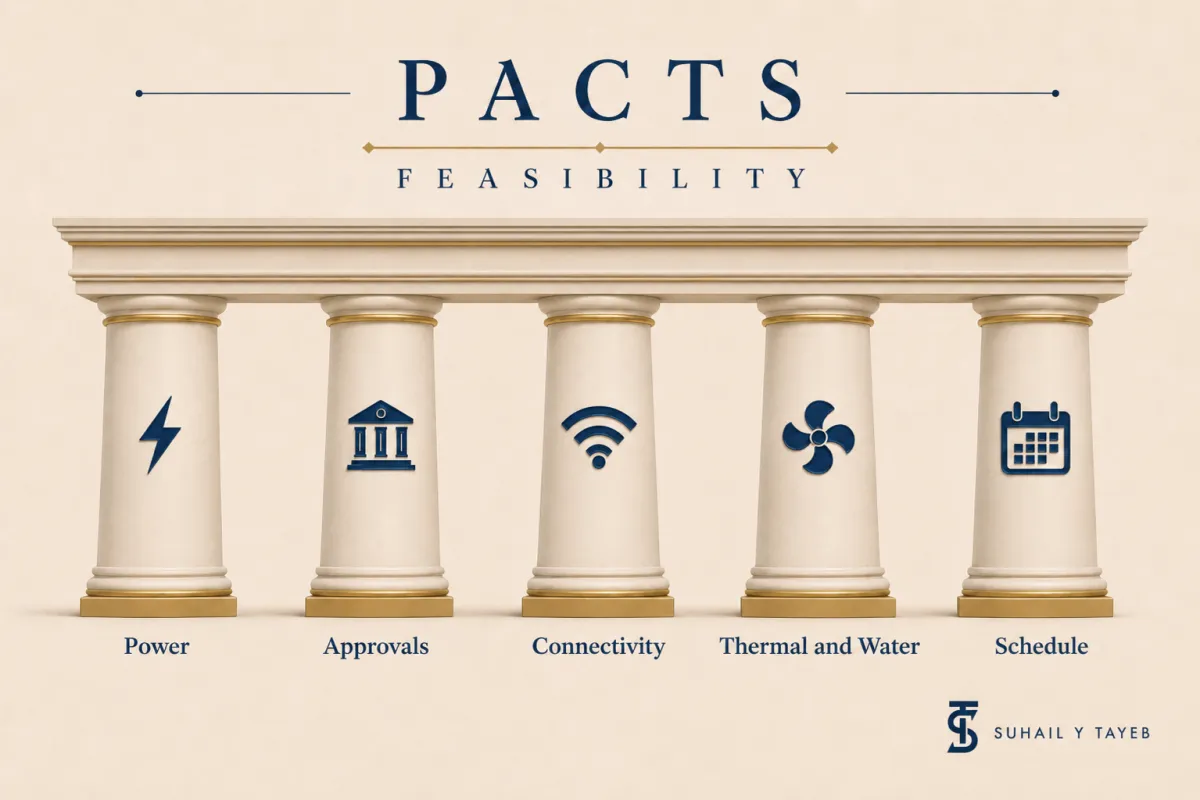
Five conditions that determine whether an opportunity deserves to advance beyond an initial screen.
Every AI infrastructure opportunity arrives with a story attached: a site, a power claim, a fiber map, a development schedule, a customer conversation. The story is usually reasonable. Whether it is real is a separate question, and answering it requires more than reviewing each piece individually. It requires a way to ask whether the pieces actually converge.
That is what PACTS does. I use it as the first level of the decision process, the screen an opportunity has to pass before it earns further diligence. It examines Power, Approvals, Connectivity, Thermal and Water, and Schedule.
The Five Conditions
Power asks whether electricity can actually be delivered at the required scale, location, cost, quality, and time. A power claim is a starting point, not a conclusion.
Approvals asks whether the project's formal, institutional, and social permission pathway is durable enough to support development, not simply whether a permit is technically obtainable today.
Connectivity asks whether network infrastructure is not merely nearby, but genuinely suitable and resilient for the intended use.
Thermal and Water asks whether cooling and water systems can operate effectively while remaining compatible with the site's environmental, regulatory, and public context.
Schedule asks whether the project's critical dependencies become available while their respective windows still overlap, since each one can be individually on track while the project as a whole misses its opportunity.
Why PACTS Is a Screen, Not a Verdict
These five conditions are not independent checklist items to be scored and summed. They interact. A cooling decision can change what an approval process requires. A power delay can outlive a customer's deployment window. A project can secure every approval it needs and still lose momentum before construction begins because one of the other conditions shifted underneath it.
A weakness in a single condition can often be solved with time, capital, or a different approach. Misalignment across several conditions at once can fundamentally change what the opportunity actually is.
Passing PACTS does not mean a project is safe. It means the project is not yet impossible. That distinction matters, because it sets up the next two questions any real opportunity still has to answer: where does it become fragile, and does it actually work for the client it's being built for.
PACTS asks the first question every opportunity should have to answer: Can this project exist?
If that answer remains unclear, everything downstream, the diagnostics, the client fit, the capital, deserves greater scrutiny before it gets built on top of an unresolved assumption.
Related Idea: A Site Is Not A Project
© 2026 Suhail Y Tayeb. All rights reserved.