
Multiple providers are not the same thing as multiple paths.
Fiber proximity gets treated as a simple checkbox: is there a provider nearby, and is there more than one. That question tells you almost nothing about whether the site's connectivity will actually survive a real failure. Two providers can sell two separate contracts that run through the same conduit, the same right-of-way, or the same regional aggregation point, and a single backhoe or outage can take both down at once.
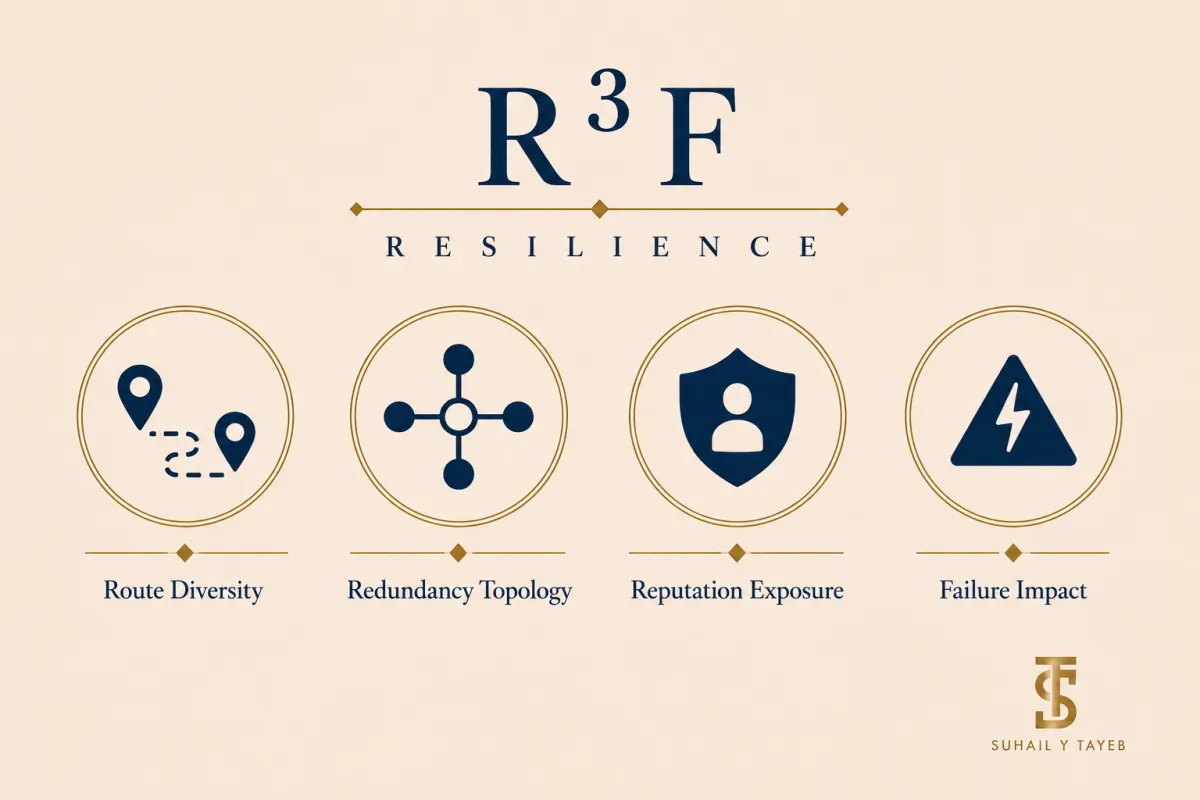
R³F is the diagnostic built for that blind spot. It stands for Route Diversity, Redundancy Topology, Reputation Exposure, and Failure Impact, and unlike a simple provider count, it asks how connectivity fails rather than how it performs on an ordinary day.
The Four Conditions
Route Diversity asks whether the physical paths carrying different connections are genuinely separate, not just contractually separate, all the way from the site to the wider network, or whether they converge somewhere upstream.
Redundancy Topology asks how the network architecture is actually built, since redundancy that looks robust on a provider's marketing map can still share a single point of failure once you trace the real topology.
Reputation Exposure asks what happens to the customer relationship, and the broader deployment, if a connectivity failure becomes visible and attributable, since the commercial and reputational cost of an outage is often larger than the technical cost of fixing it.
Failure Impact asks what actually happens operationally if connectivity is lost, for how long, and at what cost, since not all workloads tolerate the same amount of downtime, and the answer changes what "redundant enough" means for a given customer.
Why Apparent Redundancy Fails
The failure mode R³F is built for is specific: a project that looks well protected on paper, with multiple carriers and stated redundancy, discovers during an actual outage that the protection was never real. The routes converged. The topology shared a chokepoint. The redundancy existed in the contract, not in the physical network. This is rarely intentional and rarely disclosed clearly, which is exactly why it has to be diagnosed rather than assumed.
This matters more, not less, as customer uptime requirements tighten. A workload with modest tolerance for downtime can absorb a shared failure domain as an inconvenience. A workload with strict availability requirements cannot, and for that customer, undiagnosed shared risk is not a minor gap. It is the difference between a site that works and one that does not.
A framework, not a network audit.
R³F does not replace the technical work of a network engineer tracing physical routes and mapping topology. It gives everyone else evaluating the opportunity, developers, investors, and customers, the right question to ask before assuming that "multiple providers" means what it sounds like it means.
Related Idea: A Site Is Not a Project
© 2026 Suhail Y Tayeb. All rights reserved.