
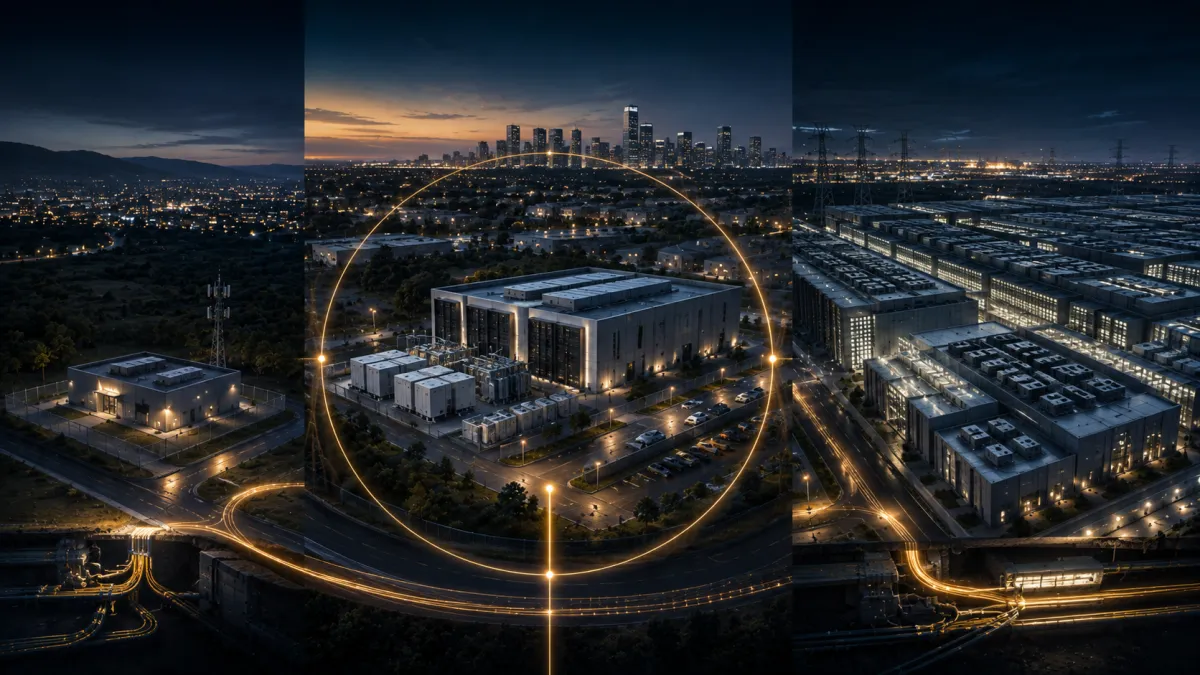
The Missing Middle: 10–40 MW
The future of AI infrastructure may not belong exclusively to the largest campuses.
Data center development is increasingly described through enormous numbers. Hundreds of megawatts. Gigawatt campuses. Multi-billion-dollar capital programs. Entire power plants dedicated to computing.
Those projects matter, but their scale can obscure another part of the market.
Between smaller facilities and enormous hyperscale campuses sits what I describe as the Missing Middle, particularly opportunities in roughly the 10 to 40 MW range.
This segment deserves more attention because not every customer needs a hyperscale campus, not every workload has the same infrastructure requirements, and not every market can support development measured in hundreds of megawatts.
Bigger Is Not the Same as Better
Scale creates obvious advantages. Large campuses can support enormous computing requirements, attract substantial capital, and justify major infrastructure investment.
Scale also creates constraints.
Very large loads require extraordinary power commitments. They can demand new transmission, generation, substations, water infrastructure, and extensive land. Their visibility can create political challenges, while their infrastructure requirements can substantially extend development schedules.
A smaller project does not eliminate these constraints, but it can change them.
The relevant question is therefore not simply how large a project can become. It is what scale best matches the customer, infrastructure, market, and timeline.
Workloads Are Becoming More Diverse
AI infrastructure is not a single use case. Training, inference, cloud services, enterprise computing, high-performance computing, and specialized applications can create different requirements for power density, latency, connectivity, redundancy, location, and expansion.
As AI adoption spreads beyond the largest technology companies, the geography of computing may become more differentiated as well.
Some workloads may remain concentrated in enormous campuses where power and land are available at scale. Others may benefit from proximity to population centers, enterprises, network infrastructure, existing facilities, or particular regional markets.
That creates room for infrastructure strategies that do not begin with the assumption that every successful project must become a hyperscale campus.
Existing Infrastructure Can Matter More
The Missing Middle can also change the development equation for existing assets and secondary markets.
A location capable of supporting 15 or 25 MW may be irrelevant to a developer searching exclusively for a 300 MW campus. The same location could be strategically significant to a customer seeking near-term capacity, a particular network position, access to an underserved market, or an expansion path that does not require hyperscale economics.
Existing buildings, substations, fiber routes, industrial properties, powered land, and other infrastructure may therefore have value that is overlooked when the market evaluates every opportunity against hyperscale requirements.
Near-Term Delivery Can Compete With Ultimate Scale
The Missing Middle connects to a larger principle within AI infrastructure: Capacity only has value relative to a customer's requirement and clock.
A customer that needs 20 MW relatively soon may place little value on the promise of 200 MW many years from now.
The ability to deliver a smaller amount of capacity with greater certainty can therefore create competitive advantage.
That is why these opportunities should first be evaluated through PACTS: Power, Approvals, Connectivity, Thermal and Water, and Schedule.
Can the project actually exist?
But PACTS alone is not enough.
A viable 20 MW project may still be irrelevant to a customer that requires 50 MW of expansion capacity. A power-rich site may be too far from the users a latency-sensitive workload must serve. A facility that can eventually deliver may miss the customer's deployment window entirely.
That is where LENS² becomes important.
The Missing Middle Through LENS²
LENS² evaluates infrastructure through the client's operational reality:
Latency
Expansion Path
Near-Term Delivery
Stability
Those requirements are interpreted through the multiplier:
² = Workload × Uptime
This changes the question from:
"Is 20 MW enough?" to: "Is 20 MW enough for this workload, in this location, by this date, with a credible path to whatever comes next?"
That is a much more useful question.
A 20 MW opportunity serving latency-sensitive inference near a major population center may have strategic value that a much larger remote campus does not.
For another workload, the opposite may be true.
The infrastructure is not inherently better because it is smaller or larger.
Its value depends on fit.

Expansion Is Part of the Thesis
The Missing Middle should therefore not be confused with thinking small.
A 15 MW first phase may need a credible path toward 40 or 60 MW. The important issue is whether that expansion can occur without restarting the infrastructure and regulatory process from the beginning.
That means the value of a Missing Middle opportunity may depend on what sits behind the initial capacity.
Is there electrical headroom?
Can additional infrastructure be added?
Does the entitlement support expansion?
Will the cooling strategy scale?
Can expansion occur without crossing a new legitimacy threshold?
A smaller first phase can be strategically powerful when it combines near-term deliverability with long-term optionality.
A Different Question About Scale
The Missing Middle is not a prediction that hyperscale development will disappear. The largest AI infrastructure projects will remain essential.
It is an argument against treating maximum scale as the primary measure of strategic importance.
As workloads diversify and infrastructure constraints intensify, the market may increasingly reward opportunities capable of matching the right capacity to the right customer, in the right location, on the right clock.
Sometimes that will mean hundreds of megawatts.
Sometimes it may mean 10 to 40.
The question is not: How big can we build?
The better question is: What does this customer actually need, and what infrastructure can credibly deliver it?
Related Idea: Power Is Not Deliverable Capacity
© 2026 Suhail Y Tayeb. All rights reserved.