
A cooling system does not stay inside the property line.
Thermal and water decisions get evaluated as engineering problems first: what cooling technology fits the load, what the mechanical system costs, whether the site has adequate water access. Those are real questions, but they are not the only ones that determine whether a cooling strategy survives contact with the public. Cooling systems are visible, audible, and locally felt in ways that most other infrastructure decisions are not, and that visibility creates a second layer of risk that a purely technical evaluation will miss.
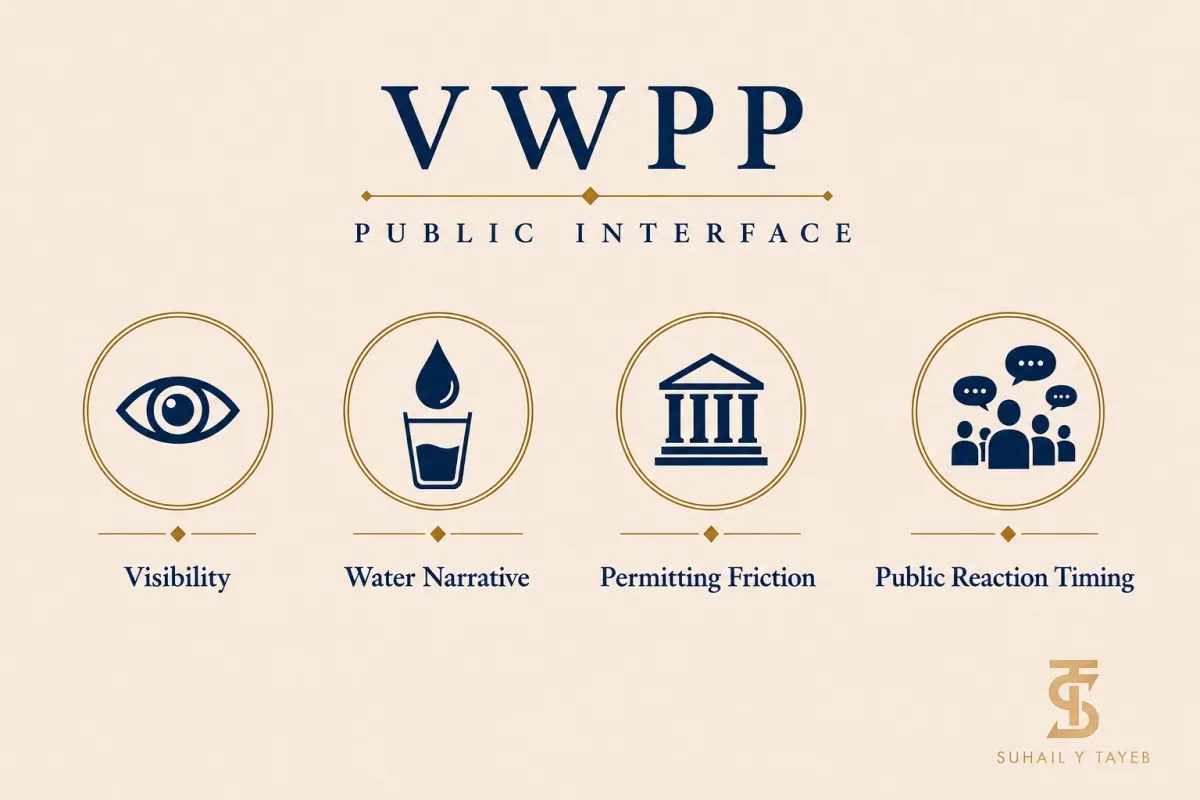
VWPP is built for that second layer. It stands for Visibility, Water Narrative, Permitting Friction, and Public Reaction Timing, and it treats the cooling strategy as a public interface, not only a mechanical one.
The Four Conditions
Visibility asks what neighbors and the surrounding community can actually see, hear, and notice about the cooling system, including visible plumes, sound, and any physical presence that makes the facility legible from outside the property line.
Water Narrative asks how the project's water use gets described and understood publicly, since the same water consumption figure can be framed as negligible or alarming depending on who is telling the story first and how clearly the project has explained it.
Permitting Friction asks which additional agencies, review layers, or conditions get triggered specifically because of water and thermal choices, since these can introduce entirely separate approval pathways beyond the core zoning and construction permits.
Public Reaction Timing asks when concern actually surfaces relative to the project timeline, since a concern raised early can usually be addressed in the design, while the same concern raised late, after commitments have hardened, becomes a fight rather than a design conversation.
Why This Gets Missed
Cooling systems do more than reject heat. They also ingest the environment around them, ambient temperature, air quality, pollution, and humidity, all of which can undermine assumptions made during design if the site's conditions were not fully understood. That ingestion side is a technical risk. The narrative side, how the community understands and responds to what the system does, is a separate and equally real risk that engineering alone does not manage.
A technically sound cooling strategy can still become a development problem if the public conversation about water and visibility starts late, is handled defensively, or is discovered by the community before it is explained by the developer. VWPP is a way to get ahead of that sequence rather than react to it.
A framework, not a substitute for engineering.
VWPP does not replace the mechanical and environmental engineering required to select and size a cooling system. It adds the questions that determine whether a technically correct choice also survives the public and regulatory process it has to pass through.
Related Idea: The Local Balance Sheet
© 2026 Suhail Y Tayeb. All rights reserved.